
Chaco Canyon and Beyond
Perspectives from the Southwest US

I try to be pretty consistent about posting here on Substack every other week. But our activities during past several weeks didn’t let me live up to that “rigid” standard! We spent that time in Colorado following our grandkids as they rode in competitive bike races. It was a fun, exciting family time, but we also explored four national monuments and parks that focused exclusively on significant Native American cultural sites.
This was our third visit to Mesa Verde (spread out over about five decades!) but it was only our first trip to Aztec Ruins, Chaco Canyon, and Chimney Rock. We hit all four sites over a four-day tour and were really gratified about at how well they all fit together into a coherent story. However, it was also really startling how much of that story provided some perspectives on Good Earth State Park and Blood Run National Monument back home!
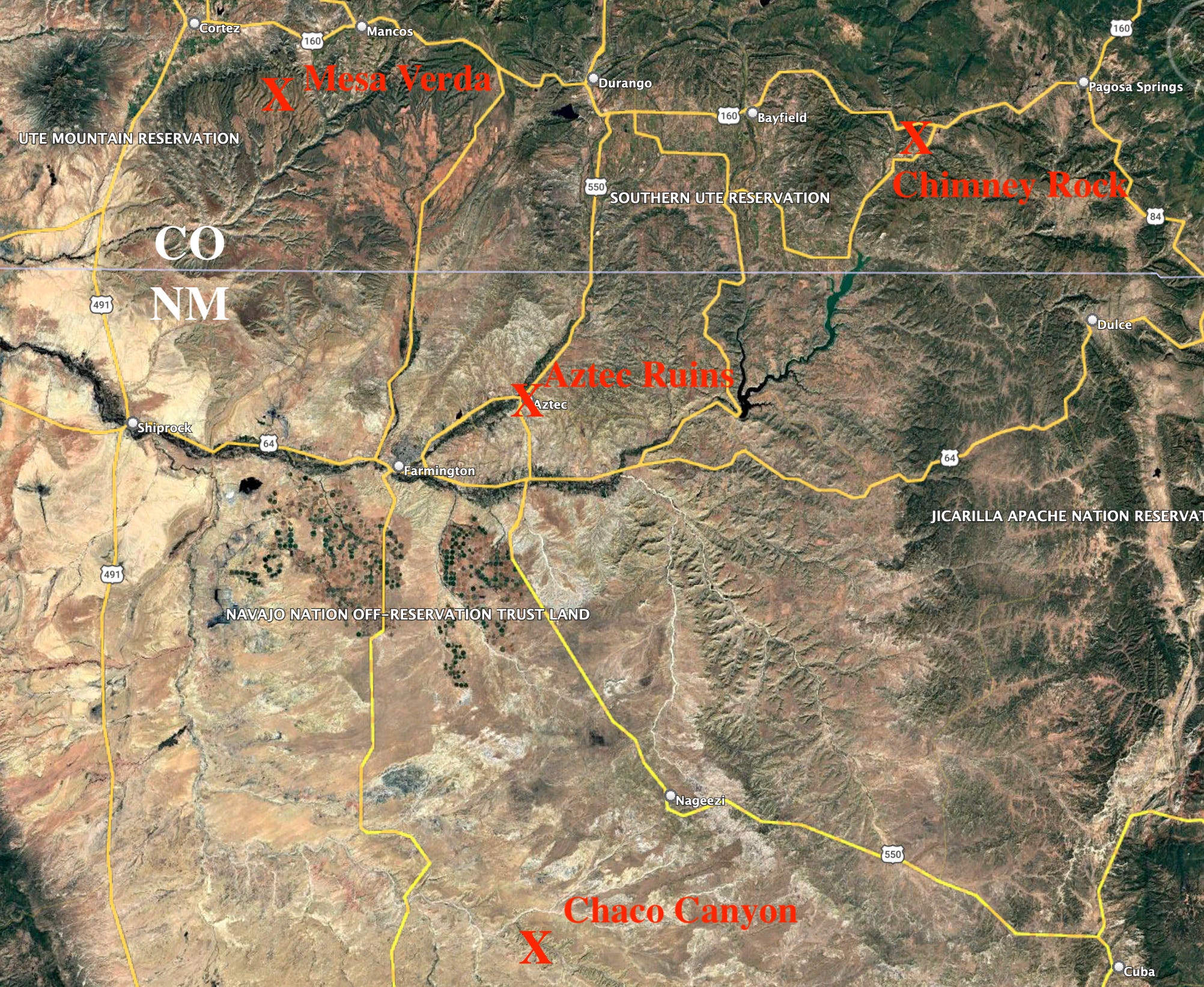
Figure 1---- Relative locations of Mesa Verde, Aztec Ruins, Chaco Canyon, and Chimney Rock in Colorado and New Mexico. Image modified from Google Earth.
The regional setting for the four archaeological sites is shown in Figure 1. It’s important to recognize that the Ancestral Puebloan culture that built these structures still lives as a vibrant presence in contemporary tribal nations such as the Hopi and Zuni, as well as in modern day pueblos including Taos, Sandia, Acoma, and Laguna. In addition, some Dine (Navaho) clans are related to the Ancestral Puebloan culture. The Utes and Apache people came into the area a bit later but have reservations near or in the Ancestral Puebloan homeland.
We visited the four sites in the order that they have been formally designated as national entities. Established in 1906, Mesa Verde National Park is the oldest. Aztec Ruins National Monument was established in 1923. Chaco Culture National Historic Park was established in 1949; it’s also been a UNESCO World Heritage Site since 1987. And President Barack Obama signed legislation designating Chimney Rock National Monument in 2012. Although our Monday through Thursday excursion happened to coincide with the simple sequence of formal recognition, the histories of the four sites are a good deal more complicated and interesting.
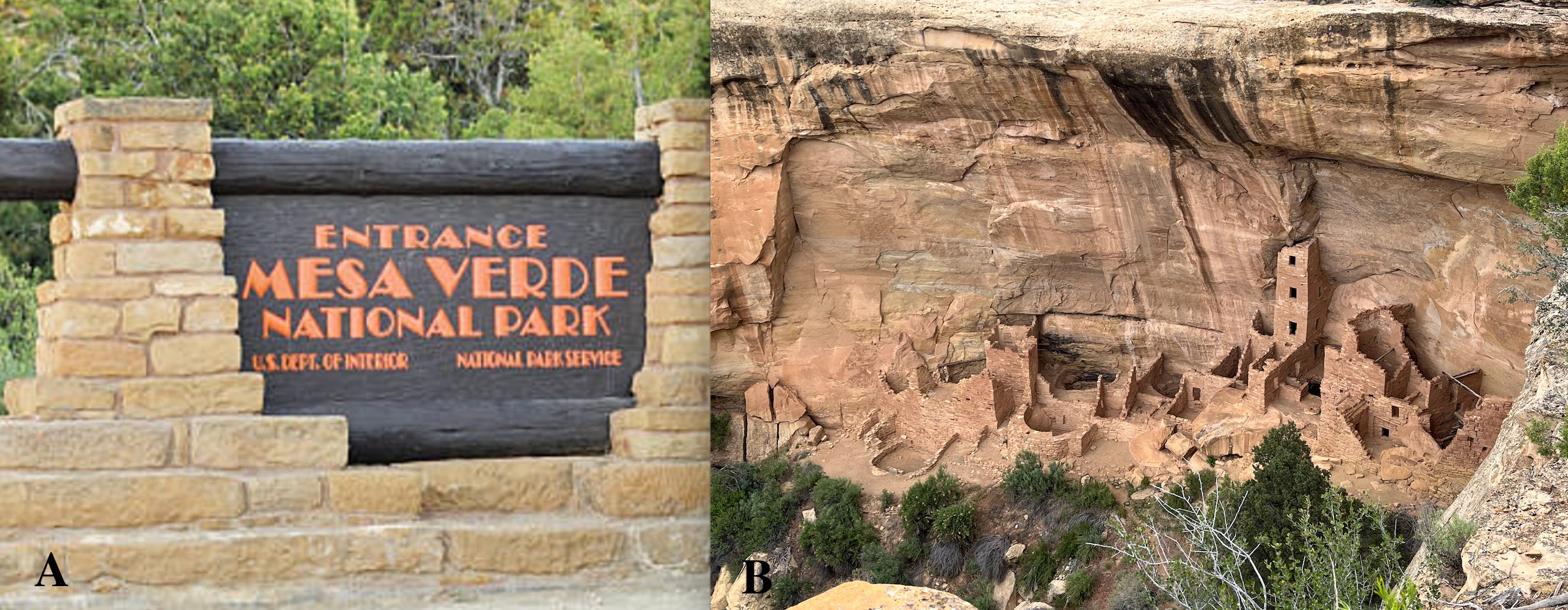
Figure 2----A) Mesa Verda National Park. B) The iconic cliff dwelling known as Square Tower House.
The first time that Margaret and I visited Mesa Verde (Figure 2-A) was during our first five years together when we didn’t have kids. When we returned several years later, we had both Sharla and Robb. But that was literally more than four decades ago and things have changed a lot! The cliff dwellings are still impressive and the park infrastructure has expanded. But the main change that I noticed was the terminology change. Back then, “Anasazi” was the word applied to a culture that occupied the mesa before the cliff dwellings were built. And there was a “mystery” about why they left. Now that culture is recognized as the Ancestral Puebloan culture because their descendants still live in the region. The people never left but simply continued to move around the region adopting to environmental and social changes.
Mesa Verde was occupied from 550 AD to 1300 AD but many of the major structures like Square Tower House (Figure 2-B) were built around 1200 AD and abandoned by 1300 AD. The Sun Temple which dates from that same later period, is a distinct D-shaped building similar to those found in Chaco Canyon. It has ceremonial circular rooms called “kivas” that are believed to reflect the circular pit houses that characterized the earliest Ancestral Puebloan occupation. Blood Run has a similar deep time record that has been recognized as an ANCIENT CAMPSITE.
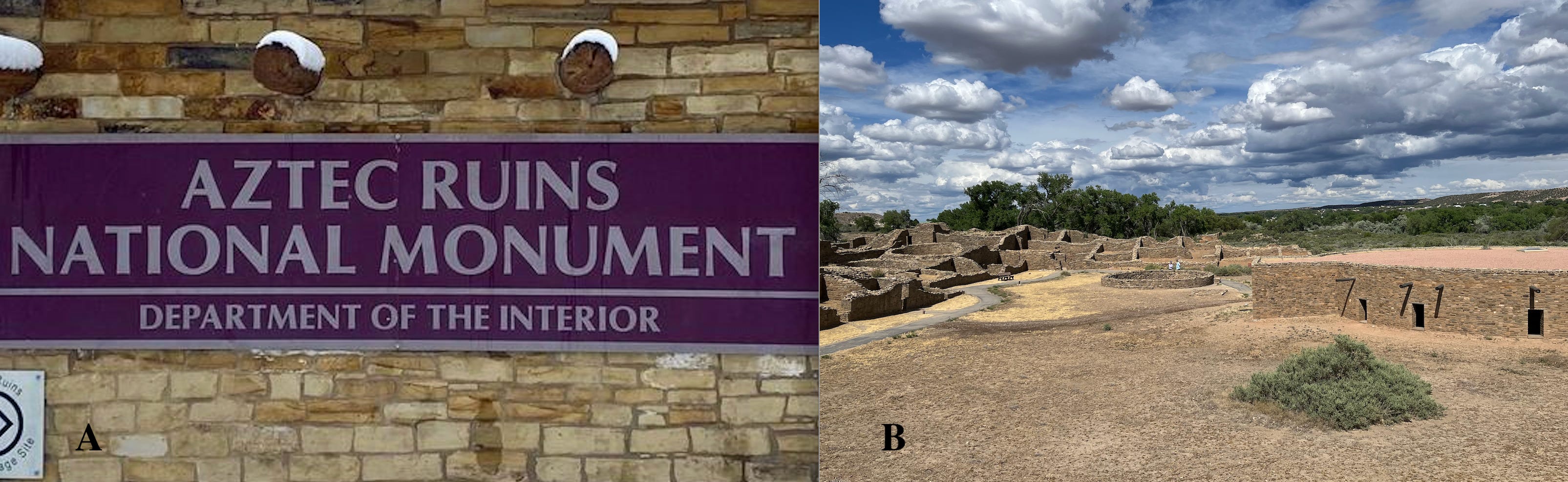
Figure 3----A) Aztec Ruins National Historic Monument. B) The reconstructed kiva on the right is part of a complex structure that includes both round ceremonial rooms and square rooms probably used for storage.
Our trip plans had always included Mesa Verde and Chaco Canyon. However, Aztec Ruins National Monument (Figure 3-A) was an unexpected stop that was a pleasant surprise. The reconstructed kiva (Figure 3-B) really helped to visualize how the space was used for ceremonies. The site was only occupied from 1100 to 1300 AD, so it generally corresponds with the later times of the Ancestral Puebloan cultural domination. D-shaped structures with multiple kivas tie the site to the huge ceremonial complex at Chaco Canyon located directly south of Aztec Ruins (see Figure 1). In fact, this location has fueled speculation about a “Chaco Meridian” that formed an axis for the northward expansion of a cultural “empire”.
Like the reconstruction of the ceremonial kiva, the Chaco Meridian is based on perspectives from the non-indigenous culture that’s currently dominant. In other words, privileged old white guys have put together the buildings and told a story with only minimal input from Native Americans. There have been similar approaches in connection with the postulated CAHOKIA “EMPIRE” influencing Blood Run.
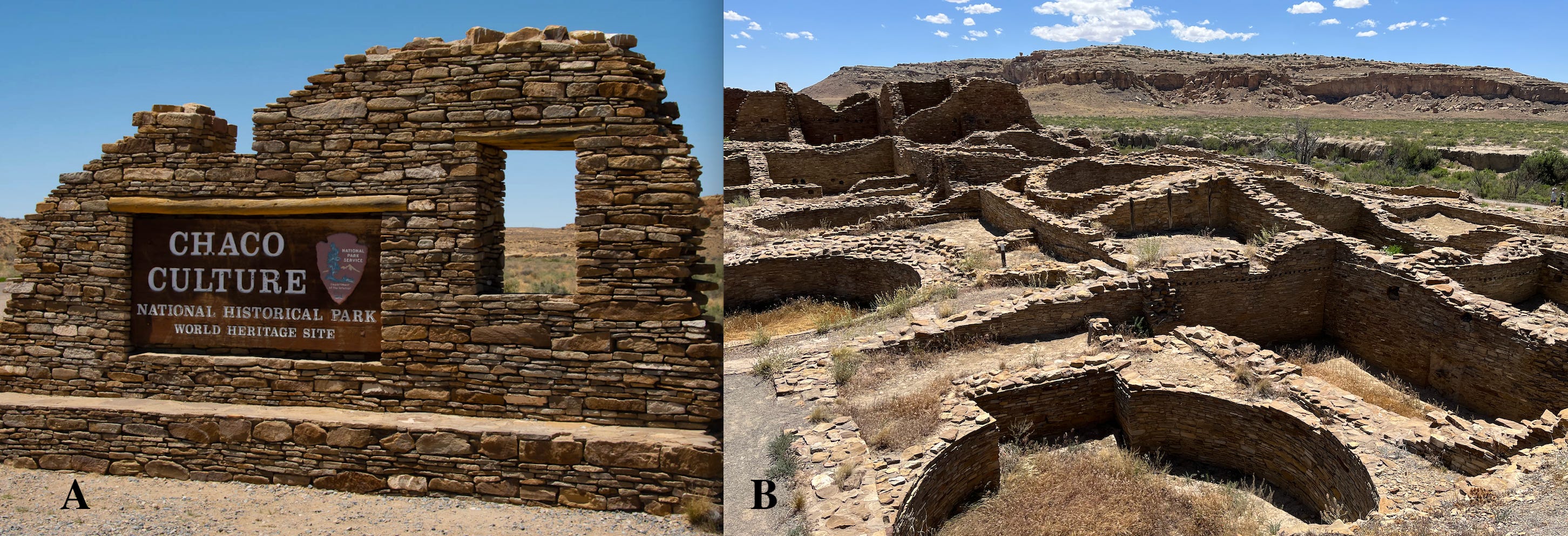
Figure 4---- A) Chaco Culture National Historical Park. B) The important structure called Pueblo Bonito in the foreground with the south wall of the canyon visible in the background.
We’ve had friends who have visited Chaco Canyon (Figure 4-A) urge us to get there some day. When we were in Santa Fe several years ago, we discussed the possibility of an expedition into the canyon, but we had concerns about the limited access and primitive conditions. We were grateful to find that the road into the park wasn’t as bad as we’d heard. Even though the most significant structures are relatively near the paved internal road, most of the park is mainly devoted to hiking. The centerpiece is Pueblo Bonito (Figure 4-B) that was built in stages between 850 AD and 1150 AD. It’s huge with about 800 rooms and more than 30 circular kivas and it represents the epitome of the ceremonial D-shaped “Great Houses” found in sites throughout the region. The floor plan of Pueblo Bonito as well as the arrangement of structures throughout the canyon are aligned with patterns in both the sky and the landscape.
Over the past few years, I’ve heard a lot and read a lot about Chaco Canyon. In fact, there are formal publications describing the similarities between Chaco and the ancient “city” called Cahokia located near present-day St. Lewis. Both Chaco and Cahokia are thought to be large ritual centers that may not have had large permanent populations, but instead periodically hosted large ceremonial gatherings. Blood Run may have had ties to Cahokia and all three (Blood Run, Cahokia, and Chaco) seem to be similar to large ceremonial MEGASITES located around the world.
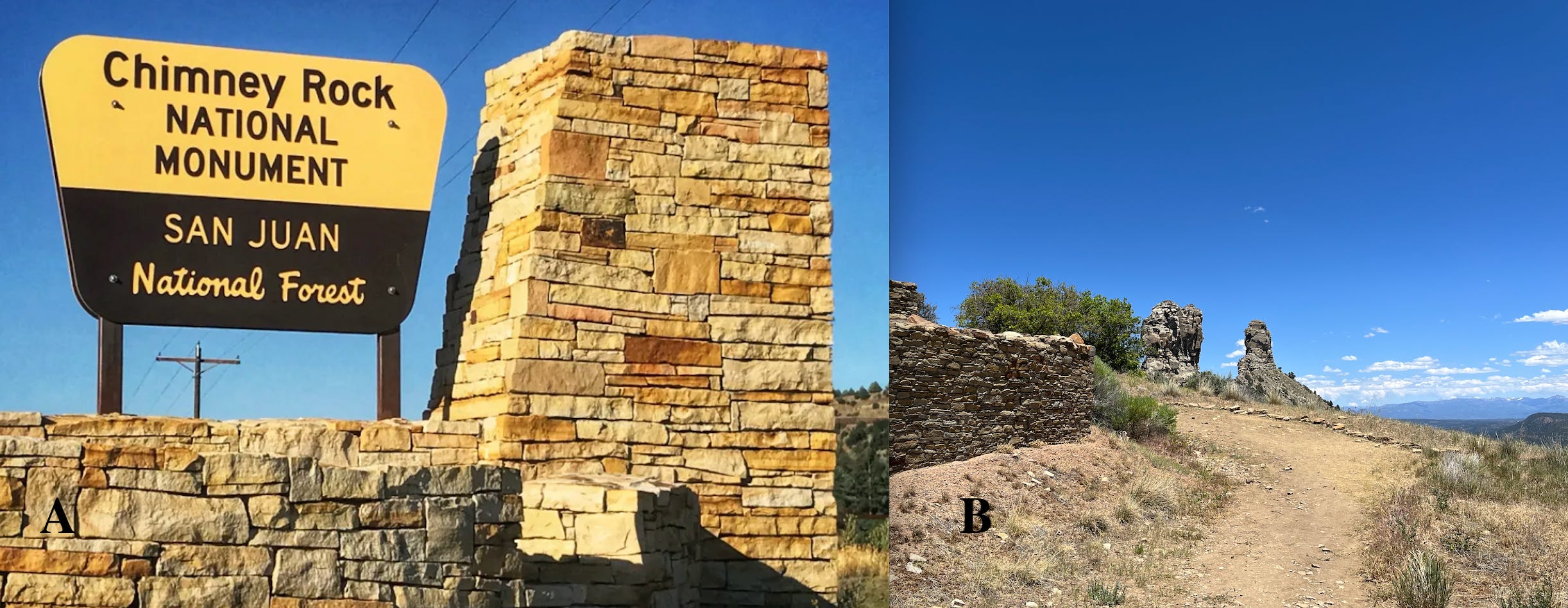
Figure 5----A) Chimney Rock National Monument. B) Building alignment with the distinctive landmark.
Similar to Aztec Ruins, Chimney Rock (Figure 5-A) was another little side trip that proved to be much more interesting than we originally anticipated. The infrastructure was all relatively new and the climb up to the landmark was pretty rigorous. However, the views and the story were well worth the effort. The isolated location provides a line of sight back down southwest toward Chaco Canyon (see Figure 1) and it is thought to have facilitated a network watchtowers and signal fires.
However, the main story at Chimney Rock is about how patterns in the landscape and sky come together in a way that is very similar to Chaco Canyon. The Great House and associated kivas here at Chimney Rock were built between 1076 AD and 1093 AD corresponding with the specific times when the moon was positioned in a distinctive location between the two bedrock pinnacles (Figure 5-B). That precise dating is possible because the wooden beams in the buildings preserve annual growth rings to tell time. So, biology, astronomy, and geology all come together to document ALIGNMENTS similar to those encountered around Good Earth and Blood Run.
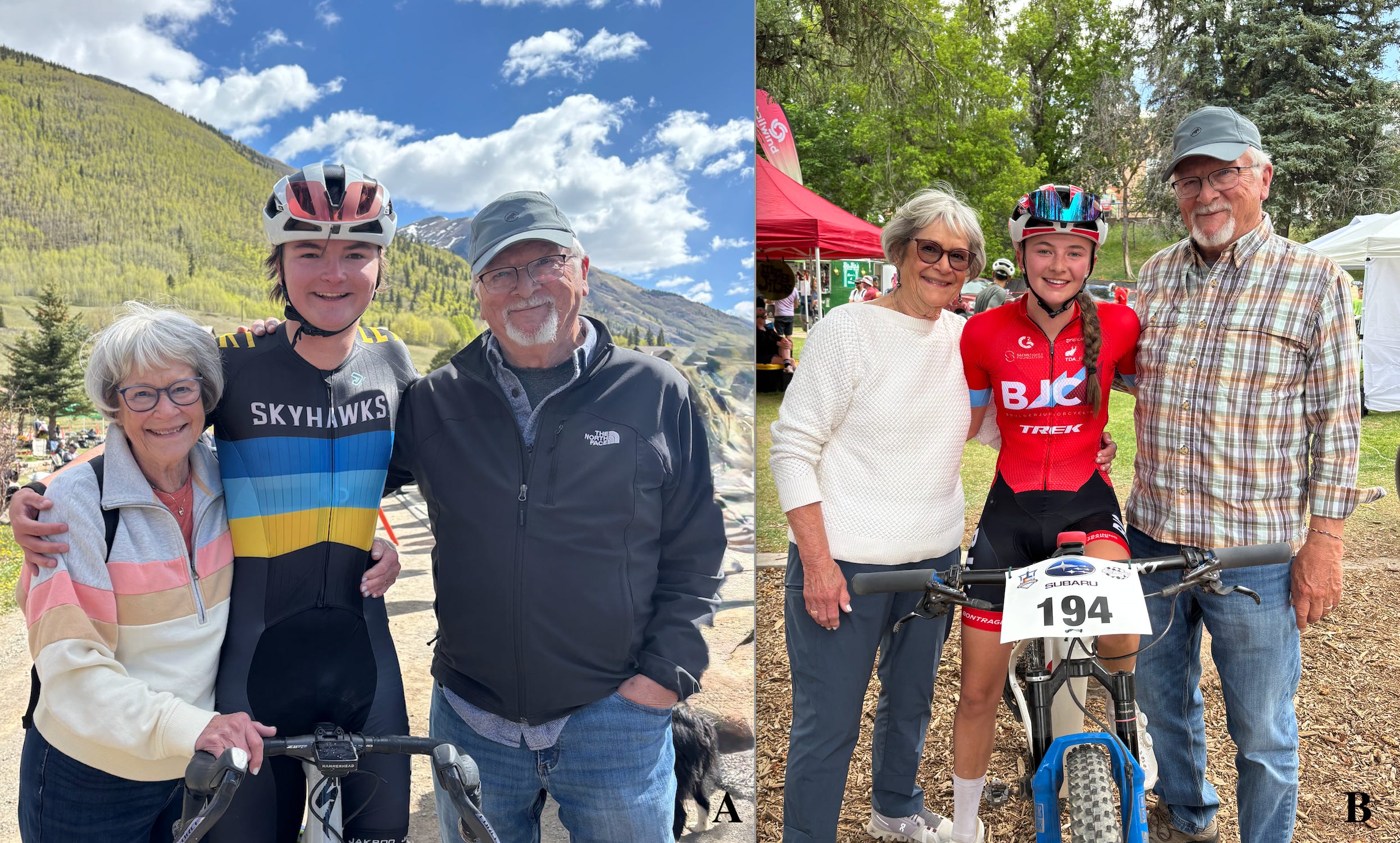
Figure 6----Bike races in Colorado. A) Gray Shurr and his grandparents. B) Nora Shurr and her grandparents.
This archaeology stuff is all pretty interesting, but the main reason that we went to Colorado was to watch bike races (Figure 6)! It’s really exciting to watch Gray and Nora participate and we’re grateful as always for the hospitality that the family provides. Parents, Robb and Joelle, provided a temporary home, cooked for us, and drove us around like they always do when we visit. Margaret and I are really lucky to have this wonderful family in Colorado, in addition to the one that we have here in Vermillion, South Dakota. It’s good to be back home with them.
POSTSCRIPT:
This “travelogue” kicks off a round of four essays that will look more closely at specific links between the Colorado archaeology sites and the cultural landscape of the Big Sioux Watershed in South Dakota, Minnesota, and Iowa. Then we’ll get back to exploring for natural springs and groundwater seeps in Good Earth State Park and Blood Run National Monument to round out the Summer.
And while we’re on the topic of “coming attractions” here’s a teaser: two more bison skulls and a possible elk skull have been collected on Lone Tree Farm at site 21RK19! Those discoveries have led to a new collaboration that promises some substantial new research directions and some compelling new stories. It’s going to be an exciting Fall!
Can't wait for the next one! The natives are finally getting their just due from historians.
Interesting and will be waiting to hear more. Did you visit Bandelier National Monument when you were in Santa Fe? It's part of the culture too. I'd visited Chaco and Mesa Verde a few times. And Chimney Rock became a monument after I'd left NM.